


The Father of Cameroon&8217s Lydol Has Been Sentenced to ...
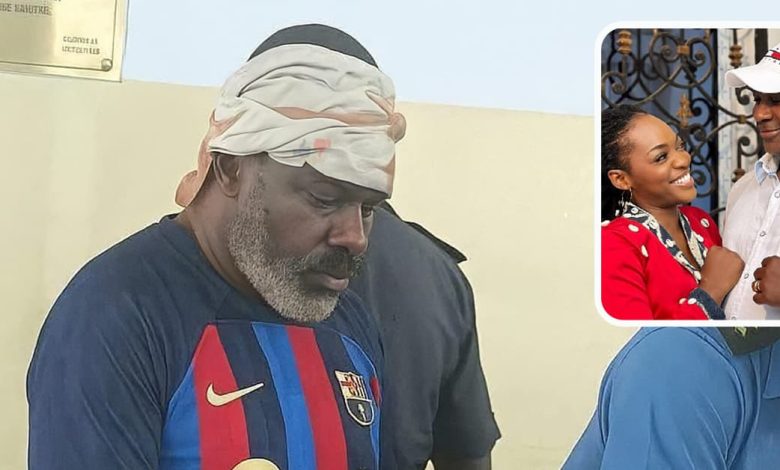
Dagobert Nwafo, the man who stabbed six-year-old Mathis-Nathaniel Ouandji to death in a Yaoundé neighbourhood last May, was sentenced to death by firing squad on Wednesday, March 18, at the Mfoundi High Court in Yaoundé. The verdict, handed down by Judge Gertrude Ekassi under Article 374 of Cameroon’s penal code, closed a case that had gripped the country for nearly a year and reopened one of the most uncomfortable debates in Cameroonian public life: what does it actually mean to sentence someone to death in a country that has not carried out an execution in nearly three decades?
The ruling landed just six days after Nwafo’s defence team had stood before the same court and argued, loudly and at length, for a full acquittal. His lawyers challenged the reliability of blood samples in the case file and questioned why an individual identified in proceedings only as “Messina” had never been brought in for questioning. They insisted his responsibility in the crime had not been formally established and asked for a complete acquittal. The court was unmoved.

The facts of the case, as established by the prosecution, are not in dispute by most observers. On the night of May 10, 2025, an altercation broke out in a bar in the Ngoa-Ekélé neighbourhood of Yaoundé between Nwafo and Paulin Ouandji, the father of young Mathis. After the dispute, Nwafo left the bar. He then returned. According to the evidence, he stabbed the child multiple times, including a wound to the throat. Mathis was rushed to the military hospital but did not survive.
What made the case far more complicated, and far more public, was a single piece of personal information that spread across social media within hours: Dagobert Nwafo is the father of Lydol, the celebrated Cameroonian slam artist. Lydol, whose real name is Nwafo Dolly Sorel, is one of the most recognizable voices in Cameroonian spoken word and music. The revelation transformed a neighbourhood crime into a national event.
When Nwafo finally addressed the court on January 14, 2026, he offered what many found to be a chilling and ultimately unconvincing account. He claimed the confrontation had begun over a beer, that he had been called a “beggar” by Ouandji, and that a second altercation near the bar’s toilet turned violent. He admitted to returning home to retrieve a weapon. He cited anger and wounded pride. He even invoked what his defense called partial amnesia. Public outrage at the amnesia argument was swift and widespread.
Throughout the trial, the prosecution leaned on a straightforward and damning reading of the evidence. Prosecutors argued that Nwafo had arrived at the child’s home armed with a long knife, that the killing was premeditated, and that nothing about the defence’s arguments could diminish the gravity of stabbing an innocent child to death. The victim’s family lawyers stood firmly behind the death penalty request. The court agreed.

Lydol responded publicly within 48 hours of her father’s arrest, posting an emotional video in which she confirmed that her father had committed a terrible and unforgivable act by taking the life of the child. She said her initial silence was not indifference but a deliberate attempt to compose herself before speaking.
https://www.facebook.com/watch/?v=1999113967165510
The video drew over 1.3 million views and 25,000 comments within two days. Reactions were deeply divided. A portion of social media users accused her of having known about her father’s violent history and staying silent to protect him. Others were just as forceful in her defence. Legal commentators and psychologists pushed back against the online attacks, with one lawyer stating plainly that blaming Lydol for her father’s actions was itself a form of injustice, the same impulse that led Nwafo to harm a child who had nothing to do with his quarrel.
She cancelled her upcoming concerts in Cameroon and France and stepped back from public life as the trial unfolded. No verified public statement from Lydol celebrating or commenting on the verdict itself had been issued at the time of publication.
A Sentence That May Never Be Carried Out
Here is where Cameroon’s justice system introduces its most uncomfortable complexity. The death sentence handed to Dagobert Nwafo is real, legally binding, and backed by one of the country’s most serious criminal statutes. Whether it will ever be enforced is a different matter entirely.
Cameroon is considered an abolitionist state in practice, with the last confirmed execution taking place in 1997. Its criminal code, revised as recently as 2016, still upholds the death penalty, particularly for offences involving terrorism. But for ordinary criminal cases, even the most brutal ones, the gap between sentence and execution has grown into what critics call a permanent legal fiction.
Under Cameroonian law, any death sentence must be submitted to the President of the Republic before it can be carried out, as only the head of state holds the authority to sign an execution order. In practice, that signature has not come for a murder conviction in roughly three decades.
Civil society organizations estimate that at least 220 people are currently on death row in Cameroon, most of them serving what amounts to a life sentence without any formal acknowledgement that the execution will never happen. The legal status of their lives sits in suspension, neither officially commuted nor ever enforced.
Cameroon has applied this de facto moratorium since 1997 without ever making it official. The country has also consistently abstained from voting on United Nations resolutions calling for a formal moratorium, and it has rejected international recommendations to abolish the penalty in law, arguing that capital punishment serves as a deterrent and reflects the will of the public.
The Last Time Cameroon Actually Executed Someone
To understand what is at stake when a Cameroonian court hands down a death sentence, it helps to look at what happened the last time one was actually enforced in a murder case.
The first confirmed post-independence execution for murder took place on August 28, 1988, when two men identified as Njomzeu and Oumbe were put to death by firing squad in Douala. They had been convicted of the 1979 murder of the Mpondo family, a crime involving multiple victims and what courts described as bloodshed with aggravating circumstances. The execution was public, with 24 soldiers assigned to carry it out twelve for each man. Reportedly, both men required a final shot to confirm death.
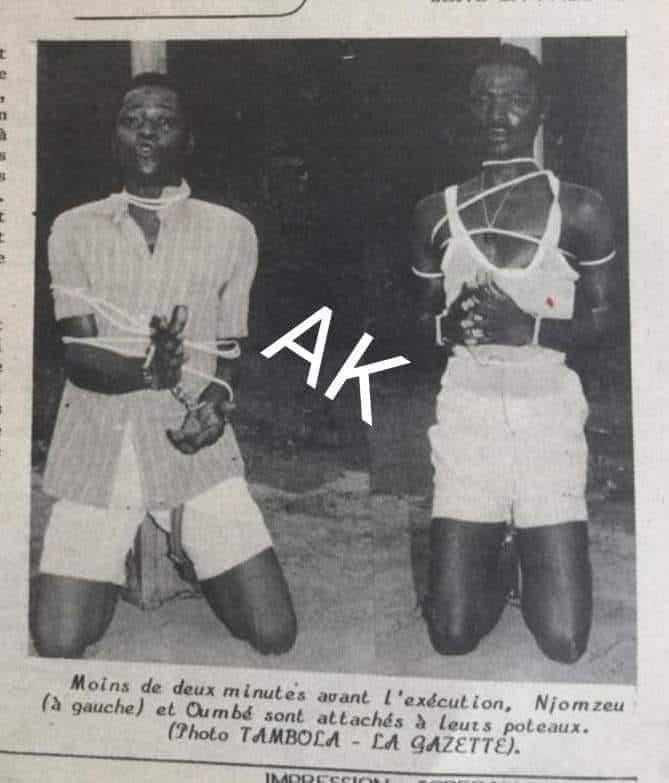
The provided document connected to this case references the Bonabéri massacre of 1979 and the men executed years later, with accounts describing one of the condemned protesting his level of involvement while the other remained silent. It was a scene that left a mark on public memory and, according to some accounts, found its way into the work of Cameroonian musical legend Lapiro de Mbanga, who used his platform to interrogate justice, state power, and the cost of human life.
The most recent confirmed execution in Cameroon, according to verified records, took place in January 1997. After that, the firing squads stood down.
Is Death the Right Answer?
The question is not whether Dagobert Nwafo committed a horrific act. The evidence, the autopsy report, and his own courtroom admission that he went home for a weapon before returning to the scene are damning enough. A six-year-old boy watching television was stabbed to death because of an adult argument he had nothing to do with. The child reportedly cried out “Tonton, tu me fais mal” “Uncle, you’re hurting me” — before collapsing in the street. Those words have stayed with Cameroon for nearly a year.
What the Nwafo case forces into the open is whether a sentence that Cameroon has not carried out in 29 years actually means anything, and whether the death penalty as a tool serves the people it claims to protect. The prosecution got the verdict it wanted. The family of little Mathis got a symbolic measure of legal acknowledgment. But Nwafo will most likely spend the rest of his life in Kondengui Central Prison alongside the more than 200 others who have been sentenced to die and are still waiting.
Human rights organizations have long pressed Cameroon to convert that reality into law. The country has consistently refused, insisting the penalty has deterrent value. Whether a sentence that is almost never enforced deters anyone is a question Cameroon has yet to answer honestly.
What is certain is that a child is dead, a family is shattered, an artist carries a weight she did not choose, and a man who armed himself and walked into a home to hurt someone will now face the rest of his days behind bars — likely alive, regardless of what the paperwork says.
The Mpondo Affair: Two Friends Before the Firing Squad
On the night of Thursday, January 7 to Friday, January 8, 1979, in Cameroon, Simon Mpondo, an engineer at Mobil in Douala, his American wife, and their young son were strangled to death inside their home in the Déido neighborhood of the country’s economic capital. Not even the family dog was spared. Suspicion immediately fell on two young men: Sylvestre Ndjomzeu, a 20-year-old housekeeper employed by the Mpondo family, and his companion Oumbé, aged 23. The pair were apprehended in Bameka, in the Western region, after allegedly attempting to sell a generator belonging to the deceased.
Yet the crime was never fully resolved. According to certain sources, the head of state at the time reportedly ordered the elimination of this family, and to this day, no one knows why this couple was murdered by the very country they had chosen to serve. Some point to an underlying dispute tied to petroleum interests and the economic stakes of that era. Despite these lingering shadows of doubt, Ndjomzeu and Oumbé were convicted and publicly executed by firing squad in Douala on August 28, 1988 — twenty-four soldiers, twelve per condemned man, were assigned to carry out the sentences.
This affair remains one of the darkest and most controversial chapters in Cameroon’s judicial history, a story in which two young men paid with their lives under circumstances that many still regard as deeply troubling.